Clear voice.
Your kind of sound.

Build it into your project. Keep it compact.
Or give your voice assistant a bigger sound.

Explore GitHub
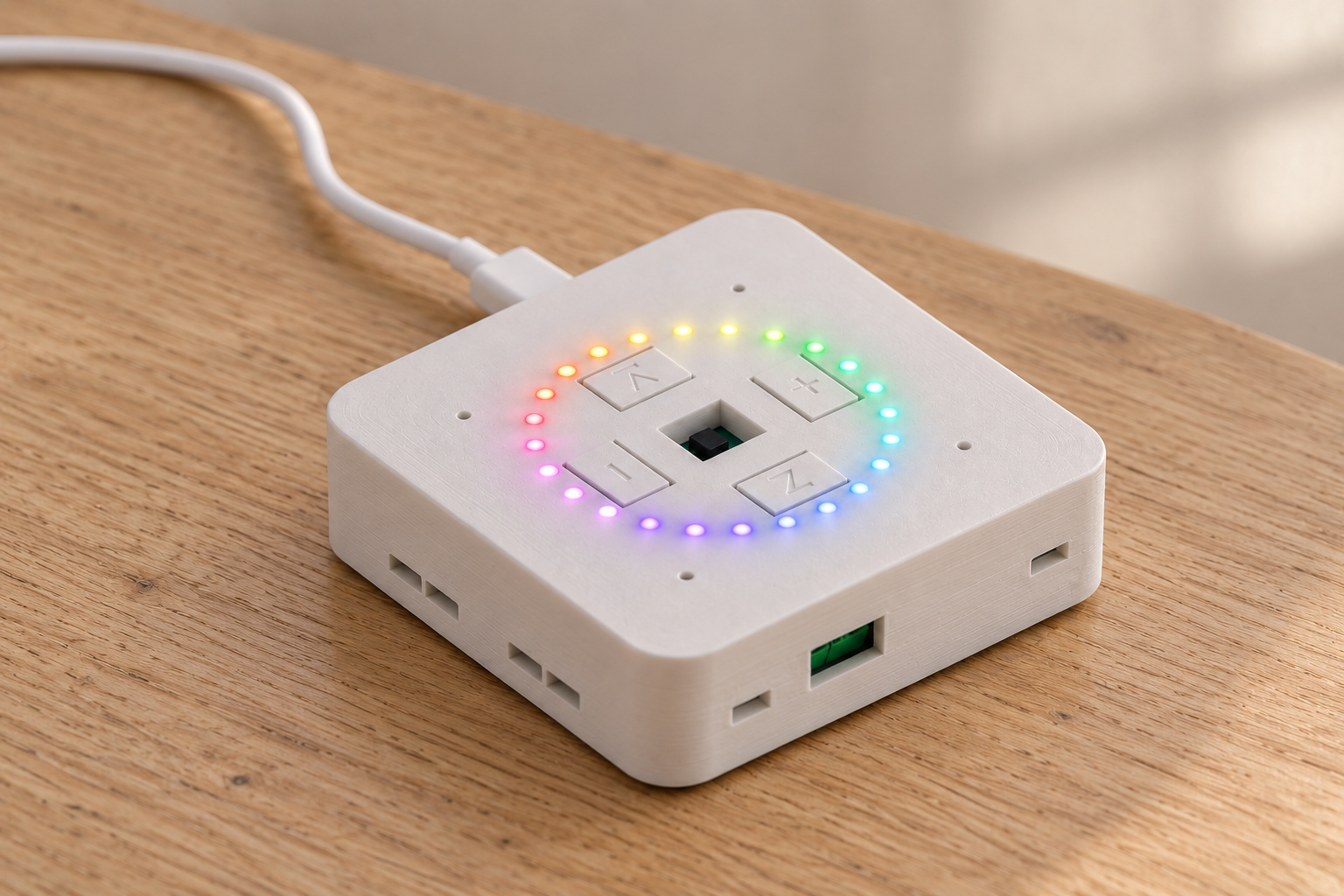
Compact Voice on a desk with its multicolour RGB light ring illuminated and USB cable connected.

4 microphonesA dedicated voice front end

XVF3800 audio DSPPristine voice, dedicated processing

2 × 25 W stereo amp*Power for external speakers

24 RGB LEDsVoice direction and visual feedback

Gesture controlConfigurable PAJ7620U2 sensor

ONE VOICE PLATFORM. THREE FORMATS.

Choose your Voice DSP+.

The same dedicated voice processing.
Choose the hardware that fits your life.
Compare what is included

01 BOARD / USB + RASPBERRY PI

Voice DSP+ board for Raspberry Pi and custom projects, with a blue-grey finish.

Voice DSP+.

The audio heart of your next build.

The Voice DSP+ board for your Raspberry Pi, robot, custom enclosure or do-it-yourself project. For makers who want to go deeper: choose your host, tune the audio and build your own controls.

Your project. Your connection.

Plug into a Raspberry Pi's standard 40-pin header for I2S audio and I2C control. Or use the board on its own as a USB sound card, with firmware updates in your browser.

40-pin Raspberry Pi models, including Zero / Zero 2 W, 4 and 5. A fitted header and the appropriate software setup are required.

Open USB Web Updater

Use cases

Robots, intercoms, kiosks, custom voice assistants, desktop AI and your next Raspberry Pi experiment.

Build it your way

Four premium digital MEMS microphones are already on the board. Add a high-performance external array when your enclosure calls for a different layout: low-noise capture with 70 dBA typical signal-to-noise ratio and tightly matched sensitivity.
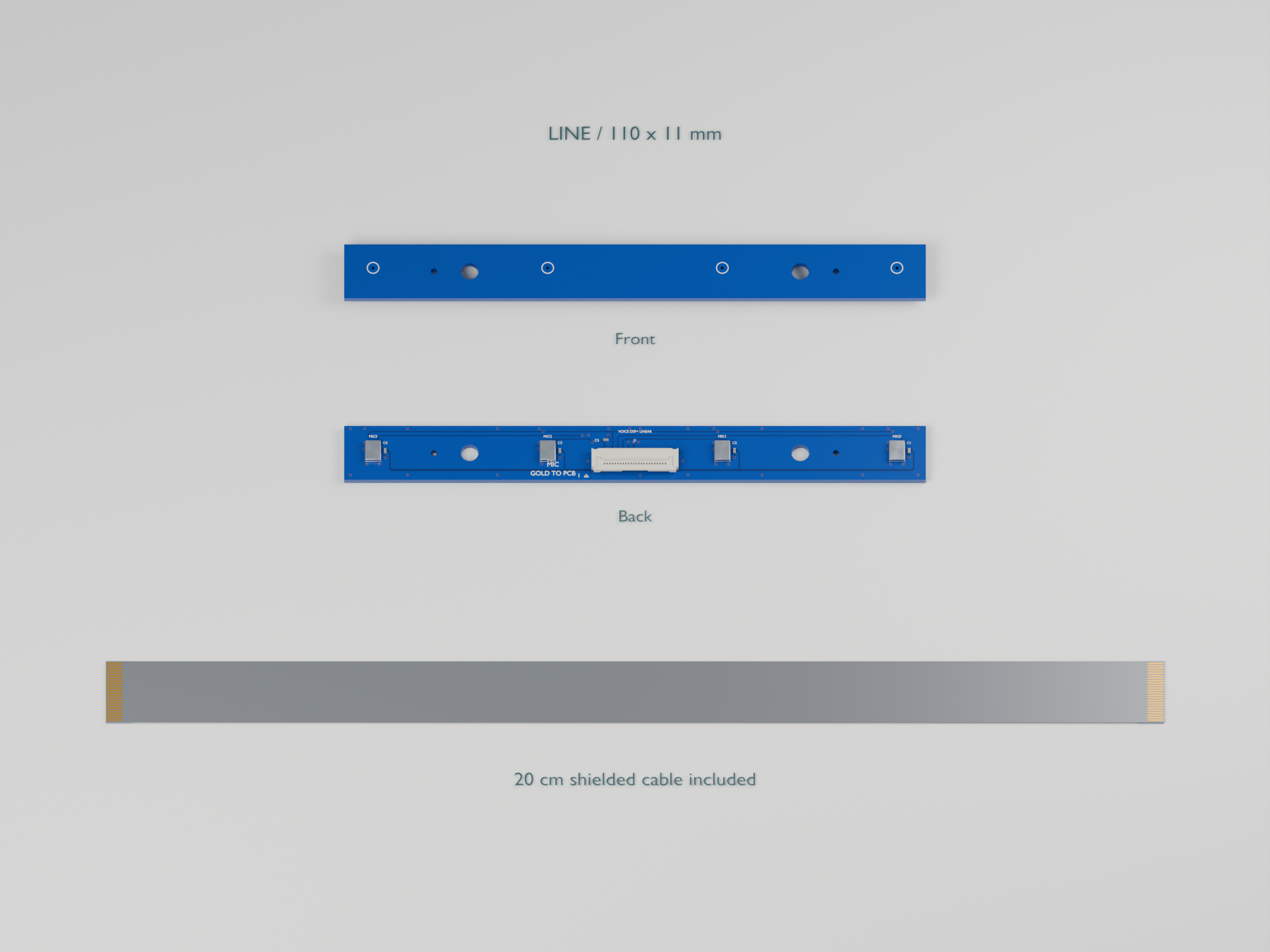
Want ESPHome and Wi-Fi? Add CoreZero S3 separately. Controller, speakers, enclosure and Raspberry Pi are not included with the DIY board.
View product

02 EVERYDAY VOICE / HOME ASSISTANT + USB

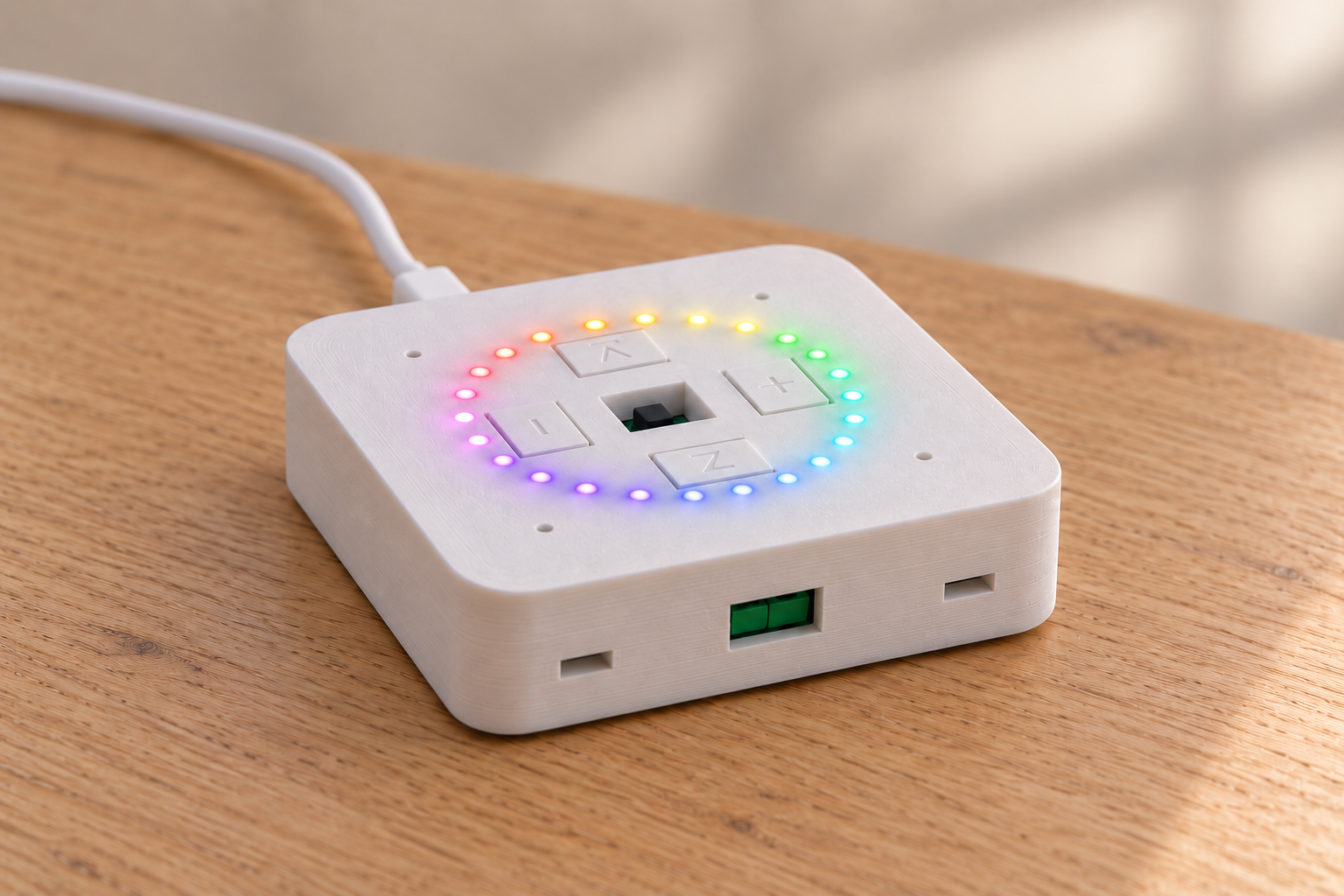
Compact Voice on an oak desk, with two front micro-speaker slots, a recessed green speaker connector, multicolour RGB ring and USB cable.

Compact Voice.

All the possibilities. Beautifully packaged.

Everything you love about the board, inside a neat 3D-printed enclosure with two small stereo speakers and an included CoreZero S3 ESP32-S3 controller. A small footprint for everyday voice.

COREZERO S3 INCLUDED AS STANDARD

Connect it to your home

Ships with ESPHome preloaded. Power it up, connect to Wi-Fi and pair it with your Home Assistant server. The separate ESP32-S3 controller is already inside, so you do not need a Raspberry Pi in the device.

Or use it at your computer

Switch to USB sound-card mode for voice AI, dictation and conference calls. Choose your microphone and playback device, then talk.

Voice first. Music now and then.

Clear replies and casual listening, with sound quality and output comparable to a good modern smartphone. For more sound, connect external passive speakers or your stereo system through the jack; these are optional.

View product

03 THE COMPLETE VOICE + AUDIO EXPERIENCE

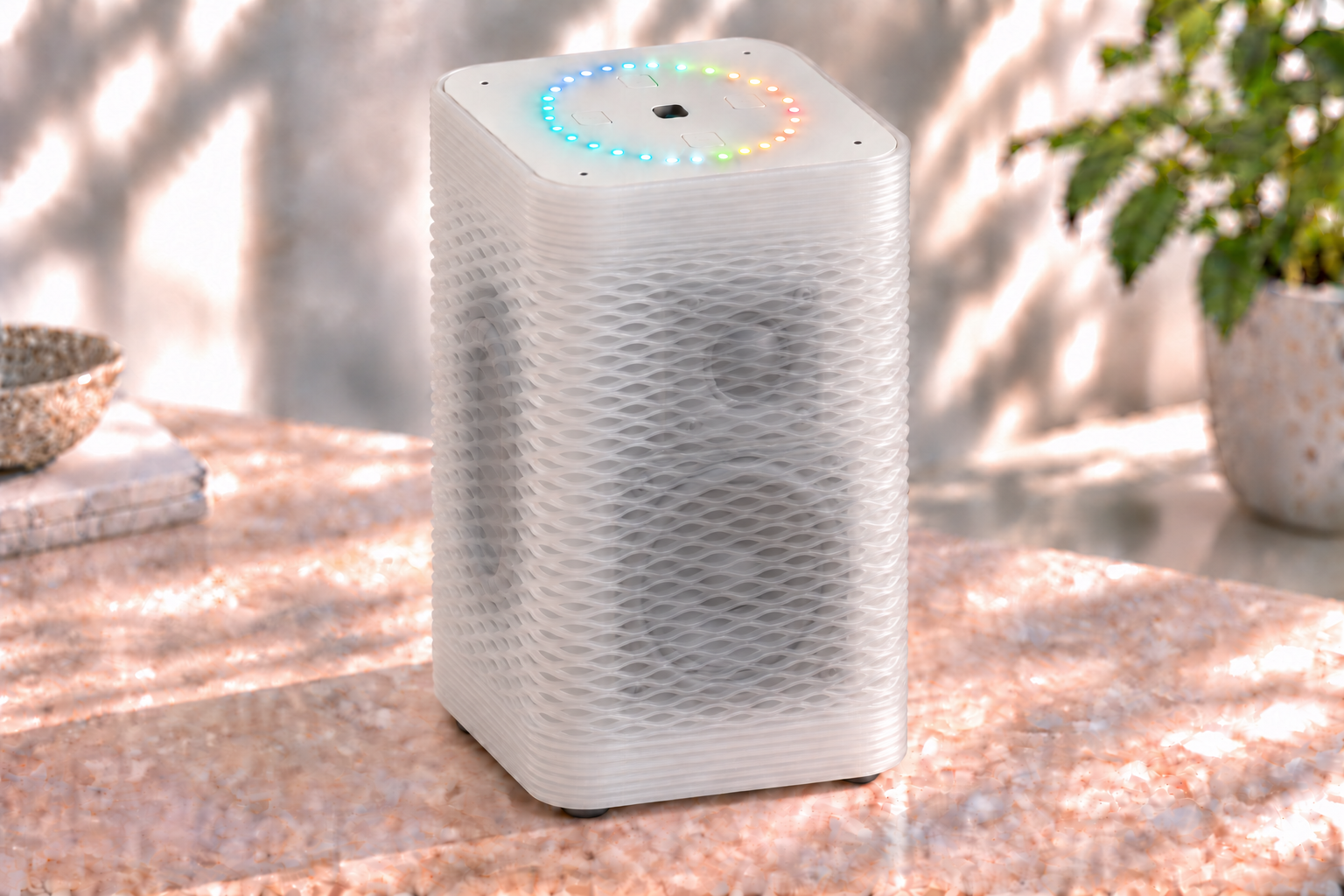
Full Speaker with Compact Voice integrated at the top, a front mid-bass driver and tweeter, and side passive radiators.

Full Speaker.

The premium experience, out of the box.

Powerful voice. Music you can enjoy. Your complete Compact Voice is integrated into a larger, approximately 24 cm tall speaker, already assembled. Connect it, set up your assistant and press play.

Built for music, too.

A dedicated mid-bass driver brings body and depth, a tweeter brings detail, and two side-mounted passive radiators support the bass. Dynamic DSP equalization and active crossover filtering shape the sound for this enclosure.

Your assistant. A bigger presence.

Home Assistant voice commands, spoken replies, your favourite playlists and a room that comes alive. CoreZero S3 and the Compact Voice module are included, along with a 45 W USB-C Power Delivery charger.

Designed as one system.

The two amplifier channels drive the mid-bass and tweeter separately, rather than a left/right stereo pair. An anti-vibration system isolates the speaker assembly from the voice electronics. No assembly required.

View product

THE SAME FOUNDATION. DIFFERENT PACKS.

What is included.

Every pack starts with the same Voice DSP+ main board.
Full Speaker includes the complete Compact Voice module.

Swipe across for each pack. Scroll down for all included items.

Items included in Voice DSP+, Compact Voice and Full Speaker
Included in the packVoice DSP+Board onlyCompact VoiceHome Assistant + USBFull SpeakerVoice + music
Voice DSP+ main board4 microphones, XVF3800 DSP, amplifier, 24 RGB LEDs and gesture control✓✓✓
CoreZero S3 controllerESP32-S3 for Wi-Fi and Home Assistant–✓✓
Compact Voice printed boxThe 3D-printed enclosure for the voice module–✓✓
2 included micro speakers / 2 × 2 W stereoFor voice. Sound quality and output comparable to a good smartphone.–✓✓
45 W USB-C Power Delivery chargerIncluded with Full Speaker––✓
External microphone / LINE arrayOptional extension with 20 cm shielded ribbon cable. Sold separately.–––
External microphone / SQUARE arrayOptional extension with 20 cm shielded ribbon cable. Sold separately.–––
For a bigger, richer sound
Full Speaker printed enclosureApproximately 24 cm tall, with an open woven cover––✓
Two-way speaker systemDedicated mid-bass driver + tweeter for music and voice––✓
2 passive radiatorsSide-mounted, supporting the bass response––✓
Dynamic DSP equalizer + active crossoverDedicated tuning for the mid-bass and tweeter––✓
Anti-vibration systemVibration-isolated speaker mounting––✓

Included Not included

Raspberry Pi and Home Assistant server are not included. External LINE / SQUARE microphone modules are optional. The included 45 W charger is distinct from the amplifier's maximum-output power conditions.

Voice DSP+, Compact Voice, Full Speaker and the LINE / SQUARE microphone extensions are available to preorder. Dispatch schedule to be confirmed; not for immediate dispatch.

FROM YOUR WORKBENCH TO YOUR LIVING ROOM

How will you
make it yours?

Build your own. Keep it compact. Or enjoy the complete speaker experience.

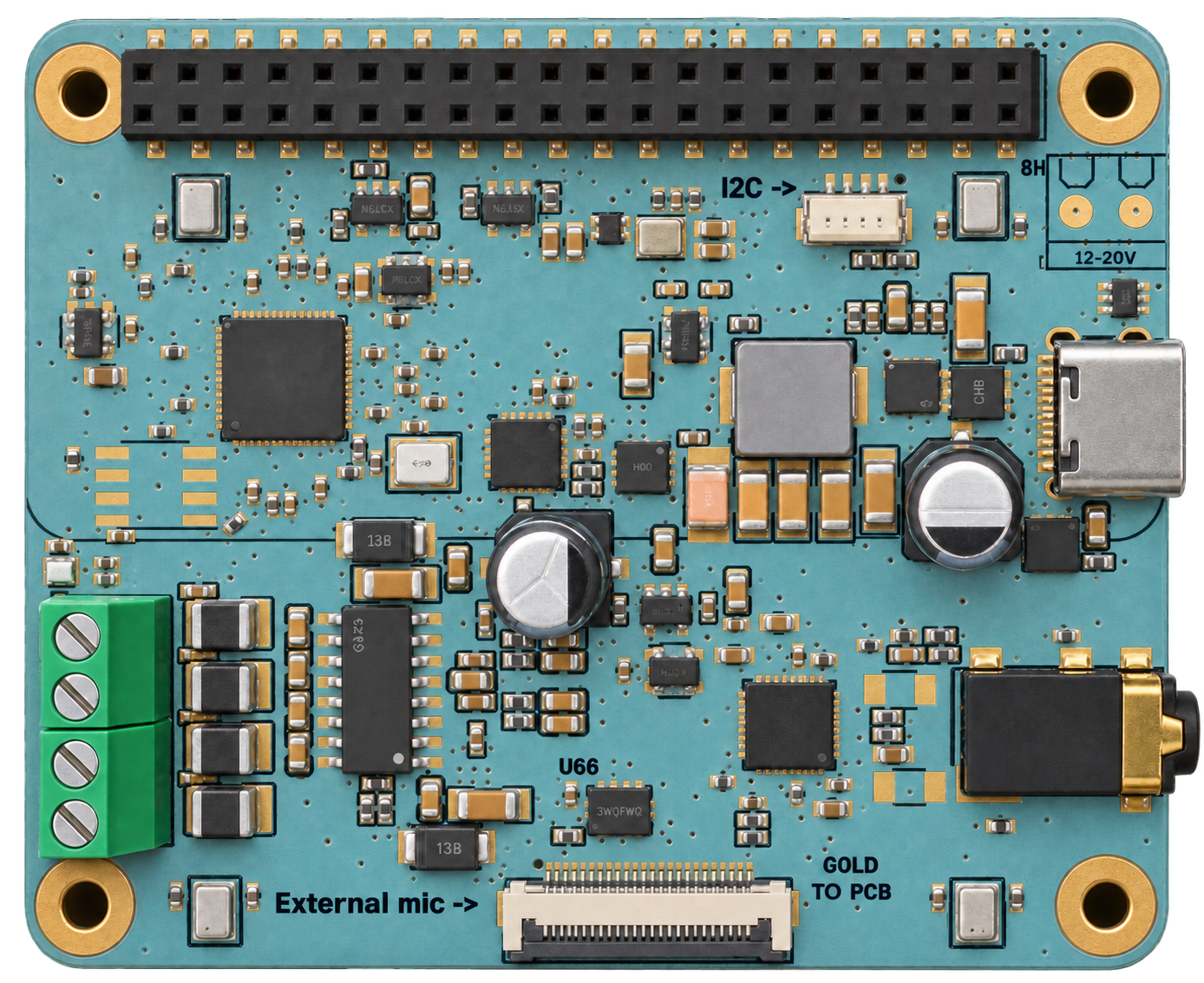
Voice DSP+ rear view with its Raspberry Pi 40-pin connector, audio outputs and expansion connectors.
Raspberry Pi 40-pin interface

FOR MAKERS WHO WANT TO GO DEEPER

Your robot.
Your code. Your sound.

Start with the board and choose the rest. Mount it on a 40-pin Raspberry Pi for I2S audio and I2C control, add CoreZero S3 for an ESPHome build, or connect straight to a computer as a USB sound card.

  1. Choose Raspberry Pi, optional CoreZero S3, or USB.
  2. Add passive speakers or connect a powered audio system.
  3. Build your app, tune the DSP and map your controls.

40-pin interface for Zero / Zero 2 W, Pi 4, Pi 5 and other standard 40-pin models. Fit a header where needed and use the matching software setup.

Open USB Web Updater
Compact Voice on a desk, viewed from the front: two small speaker slots on either side of the recessed green connector, with the RGB ring illuminated.

Micro speakers included2 × 2 W stereo

A SMALL PLACE FOR EVERYDAY VOICE

Set it down.
Make yourself heard.

A tidy companion for your home or desk. ESPHome comes preloaded on the included CoreZero S3. The small stereo speakers handle replies, calls and occasional music, with the output of a good modern smartphone.

  1. Power up and pair with your Home Assistant server.
  2. Or choose USB sound-card mode for your computer.
  3. Want more sound? Add passive speakers or connect your stereo.

External speakers, stereo system and Home Assistant server are not included. No Raspberry Pi is needed inside Compact Voice.

Assembled Full Speaker with the Compact Voice module integrated into the top.

THE PREMIUM EXPERIENCE, OUT OF THE BOX

Say something.
Play something you love.

The voice assistant and the music speaker in one finished product. A mid-bass driver, tweeter, two passive radiators and dedicated DSP tuning bring a fuller, more powerful sound.

  1. Connect the included 45 W USB-C PD charger.
  2. Set up Home Assistant, or choose USB mode.
  3. Enjoy voice control, clear replies and your music.

Delivered assembled, with Compact Voice and CoreZero S3 inside. Home Assistant use requires your own server.

Explore Full Speaker

LESS NOISE. MORE YOU.

A conversation.
Not a shouting match.

Four digital microphones and the dedicated XVF3800 DSP bring pristine voice processing to your voice, before it reaches your assistant, call or application.

BEAMFORMING

Focus on the person speaking.

The four-microphone array helps separate the direction of your voice from sounds elsewhere in the room.

ACOUSTIC ECHO CANCELLATION

Talk while sound is playing.

The DSP uses the speaker playback signal as a reference to reduce its echo in the microphones. For commands over music and natural two-way conversations.

NOISE SUPPRESSION

Let the fan fade back.

Reduce steady background noise so speech stands out. Useful in an office, a kitchen, or a robot with its own mechanical hum.

DEREVERBERATION

Less room in the recording.

Reduce the lingering reflections that make speech sound distant or hollow. Give the next stage a cleaner voice signal to work with.

AUTOMATIC GAIN CONTROL

Keep your voice in balance.

Automatic vocal-level control helps even out changes in speaking volume and distance. Less manual adjustment when the conversation moves.

DIRECTION OF ARRIVAL

See where a voice comes from.

Use sound direction for the RGB ring or your own application. A useful starting point for an interactive device that responds to the person speaking.

The DSP processes audio, not language. Wake words, speech recognition and AI run on your ESP32, Raspberry Pi or chosen host. Results depend on the room, placement, speaker volume and firmware.

Actual V2 board render showing four buttons around the central gesture sensor, surrounded by 24 RGB LEDs.
Real board render. Four buttons, one gesture sensor, 24 RGB LEDs.

VOICE IS ONLY THE BEGINNING

A wave.
A touch.
A little light.

Make interaction feel natural, even when you are not speaking.

Touch-free gestures
The PAJ7620U2 gesture sensor gives your software a configurable hands-free input. Assign actions to recognised gestures.
Four physical buttons
Tactile controls for your application, with functions defined by the installed firmware.
A built-in 24-pixel RGB ring
Show voice direction, assistant activity or your own feedback. No separate LED ring to mount on the V2 board.

Gesture actions, button assignments and LED behaviours depend on the selected software. Gesture sensing is not a room-presence radar.

INCLUDED IN COMPACT VOICE + FULL SPEAKER

ESP32-S3 inside.
More possibilities outside.

A dedicated controller keeps your voice device small and the hardware budget manageable. CoreZero S3 is included in Compact Voice and Full Speaker, so you can build a Home Assistant voice satellite without buying another Raspberry Pi for each room.

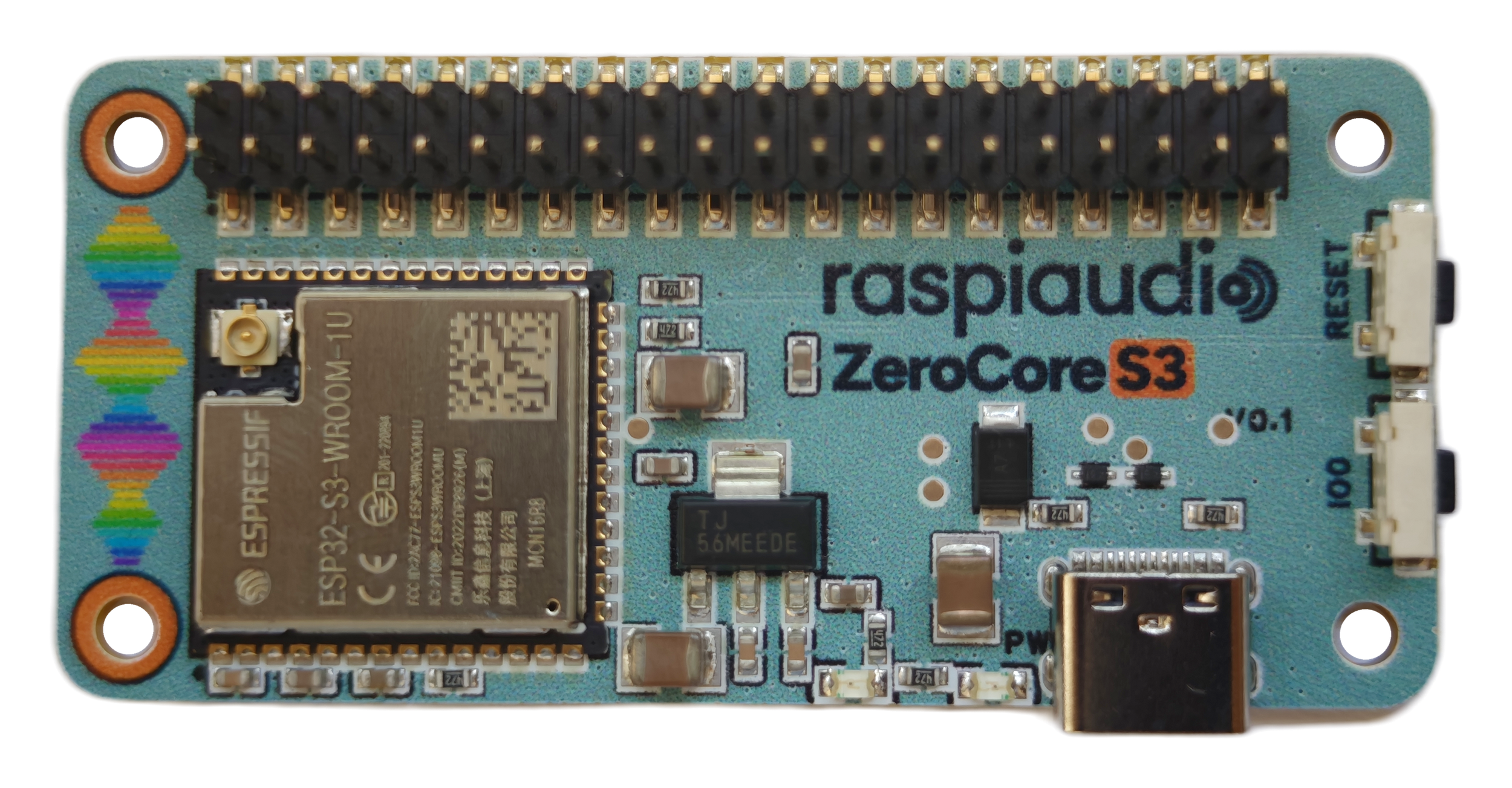
This separate ESP32-S3 board runs ESPHome, handles Wi-Fi and the voice-satellite application. The XVF3800 handles the microphones and voice processing. DIY makers can add the same controller as an option.

Meet the included CoreZero S3
CoreZero S3 ESP32-S3 controller included in Compact Voice and Full Speaker, optional for Voice DSP+.
Included: Compact Voice + Full Speaker. Optional: Voice DSP+.
  1. 01 / AUDIO

    Voice DSP+

    Four microphones, dedicated voice processing and speaker playback.

  2. 02 / CONTROLLER

    CoreZero S3

    Preloaded ESPHome, local wake-word processing and Wi-Fi connectivity.

  3. 03 / YOUR SERVER

    Home Assistant

    Your Assist pipeline, automations and chosen speech services.

Your Home Assistant server supplies the Assist pipeline. Local or cloud speech recognition depends on your setup. Wake-word detection runs on the controller or host, not the XVF3800.

KEEP THE CHOICE IN YOUR HANDS

Your assistant.
Your way of running it.

Audio hardware should open possibilities, not decide your entire software stack.

01

Process voice on the device.

Beamforming and audio cleanup happen on the board. No cloud service is needed for that part of the conversation.

02

Choose what happens next.

Use local speech services in Home Assistant, or connect the cloud services you prefer. Your host and pipeline decide where speech is sent.

03

Keep room to grow.

Explore the project sources, change your host software and extend the hardware. Start with USB today; design your next application around the same platform.

Explore the project

SAME BOARD. OPEN POSSIBILITIES.

Choose your host.
Keep your options.

Raspberry Pi for your own applications, USB for your computer, or ESPHome for your home.

RASPBERRY PI / 40-PIN

Build the thing you wish existed.

The Voice DSP+ board connects to the standard Raspberry Pi 40-pin interface, including Zero, Zero 2 W, Pi 4 and Pi 5. Direct I2S audio and I2C control give your robot, kiosk or voice application access to the hardware.

  • Microphone capture and playback over I2S.
  • SPI boot and I2C control for embedded integration.
  • Dedicated voice processing keeps the Pi available for your application.
Explore the source & integration guides
USB / WEB UPDATER

The bare board is a USB sound card, too.

Use Voice DSP+, Compact Voice or Full Speaker for real-time AI, dictation and conference calls. Choose a firmware for your hardware and mode, then install updates in a compatible browser.

  • A processed microphone and audio playback interface.
  • Standard USB audio support on your computer.
  • Browser-based updates with no command-line tool to install.
Launch USB Web Updater

A VOICE PLATFORM THAT CAN ALSO PLAY

2 × 25W*

Stereo amplification.
For the speakers you choose.

Quiet replies.
Bigger sound.

Start with Compact Voice's two small stereo speakers for replies and occasional music. Add external passive speakers for more impact, connect your stereo through the jack, or enjoy the assembled Full Speaker.

Passive speakers
Connect suitable 4- or 8-ohm passive speakers directly to the 2 × 25 W outputs. External speakers are optional and not included in the DIY or Compact Voice pack.
Powered speakers or headphones
Use the 3.5 mm stereo jack with powered speakers or your stereo system. Connection detection allows software-controlled routing. Your external audio system is not included.
Prefer a finished speaker?
Full Speaker arrives assembled, with a dedicated mid-bass driver, tweeter, two passive radiators and dynamic DSP tuning. Voice control and music in one complete system.
Meet Full Speaker

LESS TALK. MORE LISTENING.

Hear the difference.

Real recordings from the Voice DSP+ project. Listen with headphones to compare the processing.

These demonstrations use previous-generation Voice DSP+ hardware. They illustrate the audio front end, not a measured V2 performance guarantee.

ECHO CANCELLATION / OFF & ON

Music plays. You speak.

A beat plays through the board's speaker while a separate voice is recorded. Hear how AEC reduces the playback echo.

NOISE SUPPRESSION / BEFORE & AFTER

Less background. More voice.

Speech is recorded with fan-like pink noise. At seven seconds, noise suppression lowers the background.

FAR-FIELD / RASPBERRY PI DEMO

Hey Jarvis, from further away.

A local wake-word test. The model runs on a Raspberry Pi; Voice DSP+ supplies the processed microphone audio.

See the setup and source
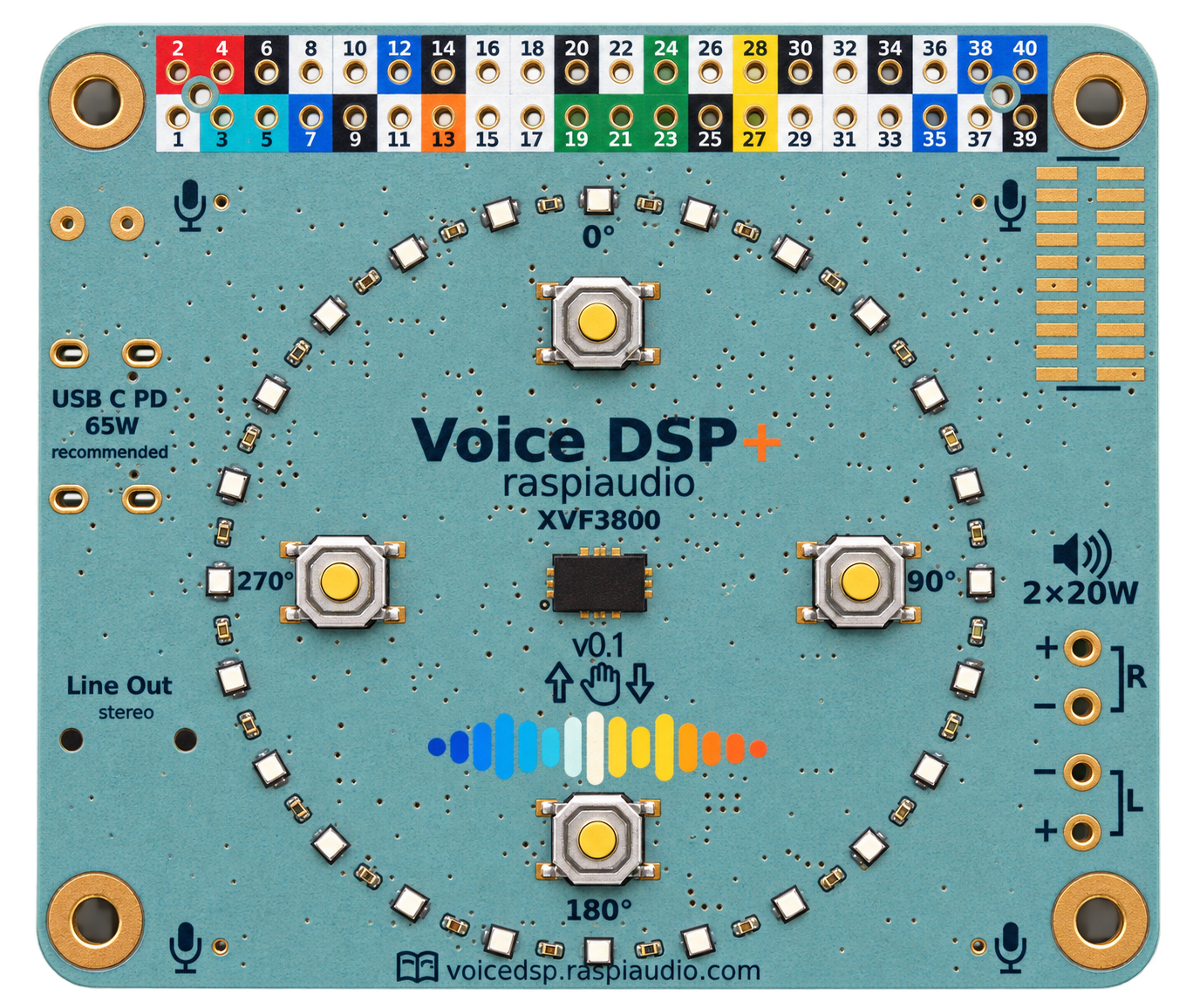
Front of the Voice DSP+ V2 board: microphones, LED ring, four buttons and gesture sensor.
Front
Back of the same Voice DSP+ V2 board: audio electronics, power, speaker terminals and connectors.
Back
One board. Two sides. The heart of every format.

BASIC FEATURES / BUILT INTO EVERY FORMAT

It starts with
a better listener.

  • Pristine voice processing. Dedicated XVF3800 DSP and four digital microphones.
  • Powerful stereo: 2 × 25 W. Amplified outputs for your passive speakers.*
  • 2 × 2 W stereo micro-speaker outputs. Micro-speakers are included in Compact Voice and Full Speaker, optional for DIY.
  • 3.5 mm stereo jack. Connect powered speakers, a stereo system or headphones.
  • Configurable gesture control. PAJ7620U2 sensor, plus four physical buttons.
  • 24 RGB LEDs. Voice direction, assistant activity and your own visual feedback.
  • Raspberry Pi 40-pin + USB. Choose direct I2S integration or a USB sound card.

Beamforming · Echo cancellation · Noise suppression

ROOM FOR YOUR IDEAS

Not a closed box.

Start with the integrated microphones. Extend the hardware when your project needs something different.

Microphones where you need them.

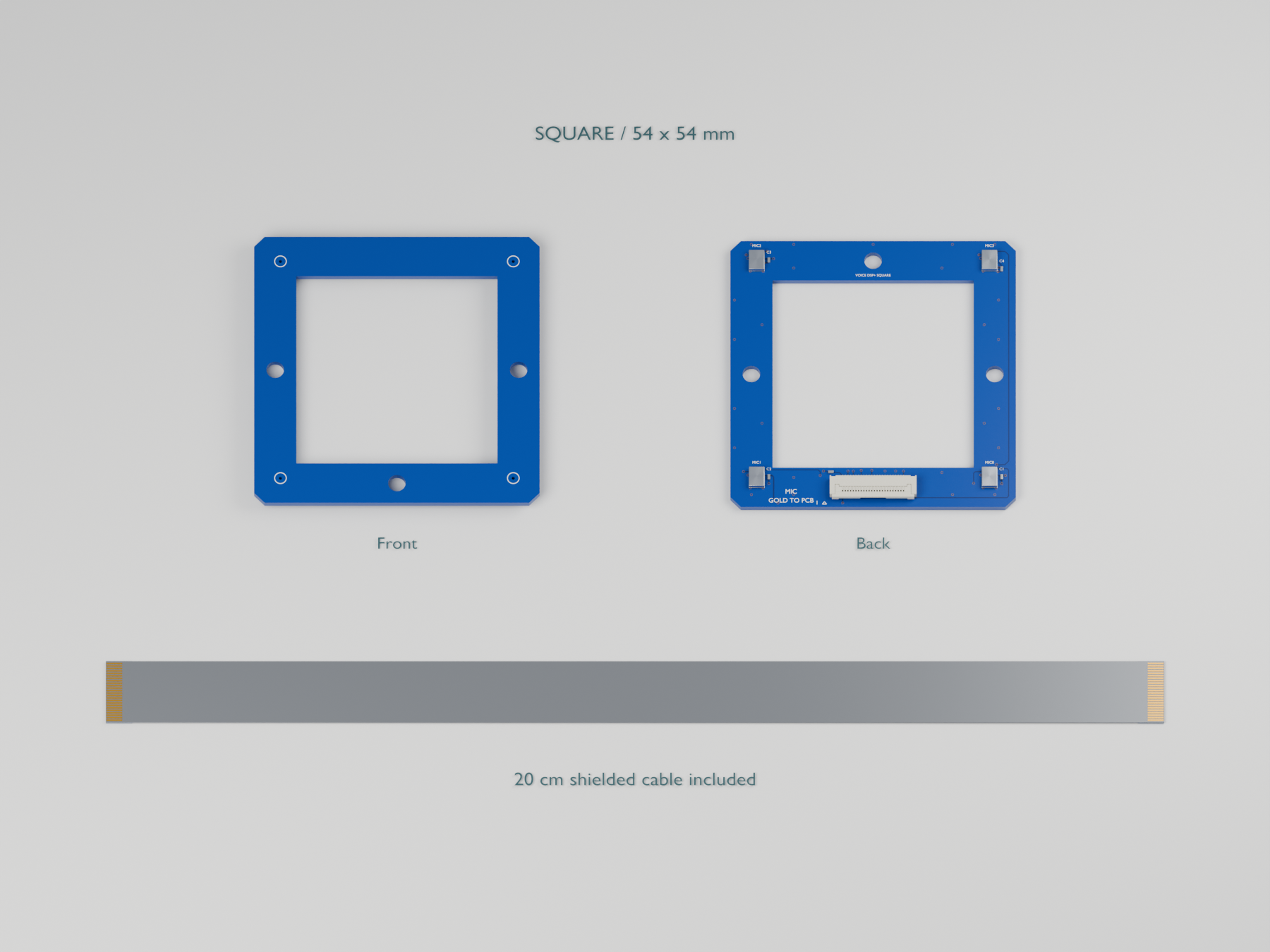
The board has four integrated digital microphones in a 44 × 44 mm acoustic square. An FPC connection also supports an optional external four-microphone module for LINE or SQUARE layouts.

Four microphones are used at a time: internal or external, not eight. External modules need a matching firmware profile and are not included in the standard packs. Power off before reconnecting modules.

A sensor port for your own ideas.

The 3.3 V Qwiic I2C connector lets you extend your build with compatible sensors. Add environmental sensing where it makes sense, away from heat inside the audio enclosure.

Temperature, humidity and presence sensors are not built in. External sensors require suitable host software; Qwiic is not Grove.

Tools you can build on.

Explore the firmware projects, host tools and integration guides. Configure the DSP from the host and build your own USB, Raspberry Pi or ESPHome workflow.

Use releases intended for your hardware revision. Published project code does not make every vendor DSP component open source; individual licence terms apply.

Explore GitHub

THE DETAILS, WITHOUT THE GUESSWORK

Inside Voice DSP+.

The same audio platform, packaged for different ways of working.

Capture & processing

Microphone array
4 digital PDM MEMS microphones; 44 × 44 mm integrated acoustic square.
Microphone characteristics
70 dBA typical SNR (20 Hz–8 kHz); 128 dB SPL AOP at 1 kHz / 10% THD; ±1 dB sensitivity tolerance. Component datasheet figures, not whole-device test results.
Audio processor
XMOS XVF3800 dedicated voice DSP.
Voice processing
Beamforming, acoustic echo cancellation, noise suppression, dereverberation, automatic vocal gain/level control, and direction of arrival.
External microphone option
FPC24 interface; internal or external 4-mic array selected at a time. LINE/SQUARE software profile must match the module.

Playback & power

Audio outputs
2 × 25 W passive-speaker outputs; 2 × 2 W stereo micro-speaker outputs; 3.5 mm stereo jack with connection detection.
Speaker amplifier
2 × 25 W at 4 ohms / 20 V with suitable speakers and power supply.* Suitable 8-ohm speakers operate at reduced maximum output.
DAC / amplifier
TLV320DAC3101 / HT326C stereo amplifier.
Power
USB-C Power Delivery. A 65 W supply with a 20 V profile is the reference for high-power use. A computer USB port alone does not provide full amplifier power.
Shared power budget
Audio, board electronics, LEDs and a connected Pi share the available power. Do not budget for full stereo output and a fully loaded Pi simultaneously.

Control & integration

User interaction
24 addressable RGB LEDs, 4 physical buttons and PAJ7620U2 gesture sensing.
Host interfaces
USB audio; Raspberry Pi 40-pin interface with I2S audio, I2C control and SPI boot integration.
Sensor expansion
3.3 V Qwiic I2C, JST 1 mm connector.
Compact Voice / Full Speaker controller
CoreZero S3 ESP32-S3 included; 16 MB flash, 8 MB PSRAM, 2.4 GHz Wi-Fi. Wake-word processing belongs to the controller/host, not the XVF3800.
Software
Firmware profiles are hardware- and host-specific. Audio sample rates and available controls depend on the release. V1 firmware is not a V2 update.

GOOD QUESTIONS

Find your
kind of setup.

The right format for your project, your space and the way you listen.

Which format should I choose?

Choose Voice DSP+ if you want the bare board for your own hardware and software. Compact Voice packages the board, CoreZero S3 and two small stereo speakers into a neat device for voice and occasional music. Full Speaker is the assembled premium option, with a larger two-way speaker system for powerful voice and enjoyable music listening.

Can the bare board work without a Raspberry Pi?

Yes. Use it as a USB microphone and sound card with your computer, or add the optional CoreZero S3 for an ESPHome voice satellite. For playback, add micro-speakers or passive speakers, or connect powered speakers through the stereo jack.

Which Raspberry Pi models use the 40-pin connection?

The board uses the standard 40-pin Raspberry Pi interface, including Zero / Zero 2 W, Pi 4, Pi 5 and other 40-pin models. Zero models need a fitted GPIO header. Older 26-pin models are outside this connection format. Use the software setup for your Pi model and board revision.

Where is CoreZero S3 included?

It is included as a separate internal ESP32-S3 controller in both Compact Voice and Full Speaker. For the Voice DSP+ bare board it is an optional accessory. See CoreZero S3.

Does Compact Voice come ready for Home Assistant?

Compact Voice and Full Speaker ship with ESPHome preloaded on their included CoreZero S3. Connect power, configure Wi-Fi and pair with your own Home Assistant server. You do not need a Raspberry Pi inside the voice device. This page previews the planned V2 delivery configuration.

How do Compact Voice's small speakers sound?

Think of a good modern smartphone: clear voice replies, useful volume nearby and occasional music. The two built-in stereo speakers suit a small desk or a voice assistant. For fuller music playback, choose Full Speaker or connect optional external speakers.

Can I connect Compact Voice to external speakers or a stereo?

Yes. Connect suitable passive speakers to the amplified outputs, or use the 3.5 mm stereo jack with powered speakers or a stereo system's line input. Those external speakers and the stereo system are not included. For high-power playback, follow the supply and speaker requirements below.

Do I have to assemble Full Speaker?

No. Full Speaker arrives assembled with Compact Voice, CoreZero S3, the mid-bass driver, tweeter, two passive radiators and anti-vibration system inside. A 45 W USB-C PD charger is included. Connect it, set up your chosen mode and enjoy it.

Is Full Speaker a stereo pair?

Full Speaker uses the board's two amplifier channels to drive one mid-bass driver and one tweeter, with active crossover filtering and dynamic DSP equalization. It is a two-way speaker system. The DIY board can instead drive a left/right stereo pair, and Compact Voice has two small stereo speakers.

Can I change the microphone layout?

The board has four integrated microphones. Optional LINE and SQUARE external arrays let you position microphones to suit your enclosure. Four microphones are active at a time, using a matching firmware profile. These accessories are sold separately.

Does the voice assistant need the cloud?

The XVF3800 processes microphone audio locally. Wake words run on your ESP32 or Raspberry Pi. Your Home Assistant pipeline or computer application decides whether speech recognition and AI use local or cloud services. A separate Home Assistant server is required for Home Assistant use.

How do I update or switch to USB mode?

Open the USB Web Updater in a supported browser and choose the release for your board and operating mode. Always match the hardware revision: current V1 images are not V2 updates. V2 software integration is still being completed.

RASPIAUDIO VOICE DSP+

Build your voice.
Choose your sound.

Choose your format

EXPLORE THE VOICE DSP ECOSYSTEM

Related products for your voice setup.

Preorders. Dispatch schedule to be confirmed.

USB ON ALL THREE FORMATS

Plug in. Select. Speak.

  1. Choose USB sound-card firmware for your board revision in the Web Updater.
  2. Connect a USB data cable and select Voice DSP as your microphone and playback device.
  3. Open your AI voice, dictation or conferencing app and start talking.

Compact Voice and Full Speaker include their speakers. With the DIY board, connect your own passive speakers or use the stereo jack with a powered audio system. USB use needs a computer, with no Raspberry Pi or Home Assistant server required.

Use a release explicitly intended for your hardware and mode. This V2 preview describes the planned range; V1 firmware must not be flashed onto V2.